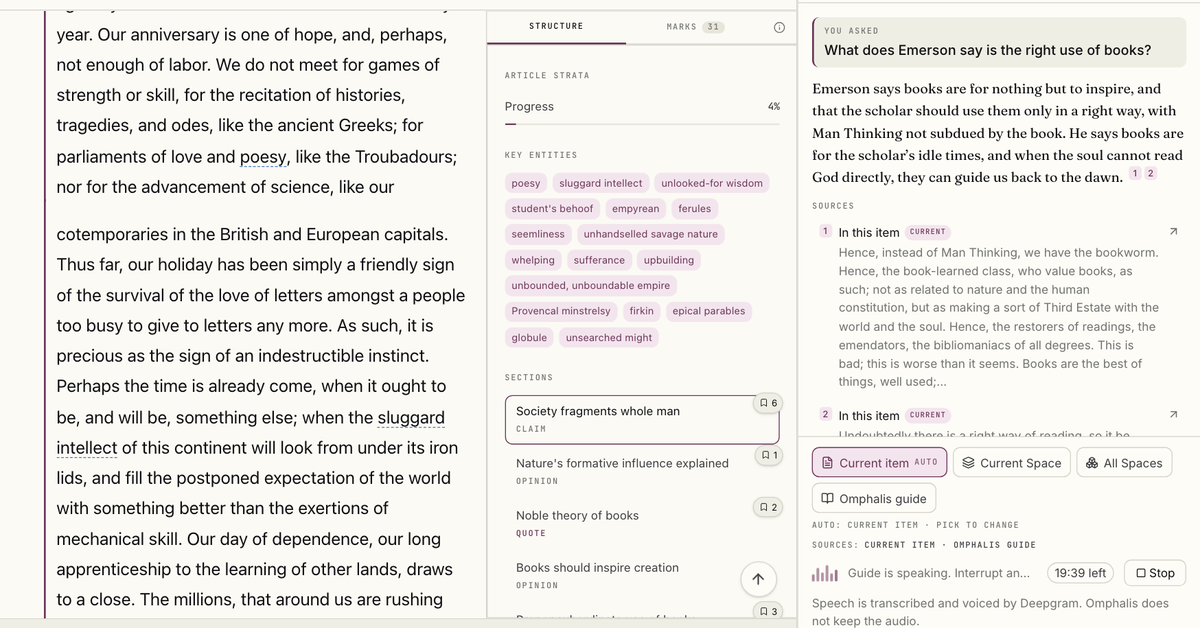
Readers can talk through articles, papers, podcasts, and videos, ask follow-up questions aloud, and open the passages behind each answer
DOVER, DE, UNITED STATES, September 30, 2026 /EINPresswire.com/ — Voxiven LLC today launched voice conversations in Ask, the question-answering feature of its reading app, Omphalis. In the Omphalis web app, a reader can talk through something they have saved, whether an article, a research paper, a podcast episode or a video, hear an answer drawn from that material and keep asking follow-up questions aloud. The passages behind each answer appear on screen as numbered sources, and choosing one opens the cited passage, highlighted, in the text.
The reader decides what Ask may draw on: the item open in front of them, a Space of related material or their whole Library. Ask proposes a starting scope from the question, and the reader can change it at any time. A fourth option, Omphalis guide, answers questions about using the app itself. Answers about the reader’s material draw only on their own Library, never on anyone else’s.
“Understanding shouldn’t require leaving what you’re trying to understand,” said Stanly Thomas, founder of Voxiven LLC, the company behind Omphalis.
A conversation that follows the reader’s next question
Some questions are easier to say than to type: what a term means, why an author made a particular move, how two claims fit together. Ask voice keeps the thread of the conversation, so a follow-up is understood as part of the same line of thought rather than a fresh search. Speaking also keeps attention on the page: there is no need to leave the text for a search box or a separate chat window.
In a demonstration recorded on Ralph Waldo Emerson’s 1837 address “The American Scholar,” a reader asks what Emerson says is the right use of books. Ask answers aloud that, for Emerson, books are for nothing but to inspire, and that the scholar, as Man Thinking, must not be subdued by them. The reader follows up with “And how does he think reading goes wrong?” The second answer draws on Emerson’s warnings about bookworms and bibliomaniacs, and its numbered sources lead to the passages it came from.
A spoken answer can close by suggesting a question worth asking next. Readers can interrupt at any moment by speaking, switch back to typing at any time and end the session by saying so.
The evidence stays on screen
Ask does not read its citations aloud; it shows them. Each spoken answer arrives in the conversation panel with numbered sources beside it, and choosing a source opens the cited passage in the reader, highlighted within its surrounding text. The explanation stays easy to listen to, and the evidence stays open to inspection. Answers point back into the text rather than standing in for it.
When the selected sources do not cover a question, Ask is designed to say so rather than fill the gap. Grounding and visible sources help readers judge an answer, but an explanation can still be wrong. The original passage remains the place to verify a claim, notice a qualification or reach a different conclusion.
How a voice session works
The voice experience is engineered for low latency. Ask begins speaking as an answer takes shape rather than waiting for the whole response, so the exchange keeps a conversational pace through several turns.
Voice runs in the browser, beside the text being discussed. Pressing Talk starts a session: Ask greets the reader by name, mentions what is open and then listens, and a live transcript shows each question as it is spoken. Speech is transcribed and voiced by Deepgram, and Omphalis does not keep the audio. A session lasts up to 20 minutes, and each question and answer stays in the conversation panel as text, with its sources, after the session ends.
One reading environment for many formats
Omphalis brings web articles, research PDFs, EPUBs, Word documents, podcast episodes and YouTube videos into one reading environment, turning audio and video into transcripts that can be read and questioned alongside written material. Someone studying a topic can gather an introductory article, a detailed paper and a recorded interview in one Space, then use Ask to explore where the sources agree, where they differ and which passages support a point.
The conversation sits beside the rest of the Omphalis reader. A structure panel maps each piece into its sections and its recurring names and terms, and dotted underlines in the text open short explanations of difficult terms and references. A reader can move from the outline to a passage, from a passage to a question and from an answer back to the text.
Notebooks support the work around a conversation. Readers can keep passages beside their own writing, and a notebook’s Ask cells answer questions from its contents, keeping cited responses and follow-up threads.
Ask voice is built for people who want to understand and return to what they save: a student asking a dense paper to walk through its method, a researcher asking where two papers disagree, a professional checking a figure before a briefing, or a listener returning to a long interview to find where a guest made a point.
Availability
Ask voice is available now in the Omphalis web app, in English. Mobile support is planned. New accounts receive a 30-day trial of every feature, voice included, without a credit card, then move to Free unless a paid plan is chosen. Voice is part of the paid plans: Pro at US$9 per month, Premium at US$19 and Scholar at US$39, each with a monthly voice allowance that grows with the plan. The Free plan does not include voice. Details are on the Omphalis pricing page.
About Omphalis
Omphalis is a reading app built by Voxiven LLC. Add a source, read its cleaned text, open explanations, ask questions and keep your notes with it. You can also listen and gather related material in notebooks. Voxiven LLC was founded by Stanly Thomas. Learn more at omphalis.ai; press information is at omphalis.ai/press.
Stanly Mathew Thomas
Voxiven LLC
email us here
Visit us on social media:
LinkedIn
YouTube
X
Ask voice in Omphalis: talking through Emerson’s “The American Scholar”
Legal Disclaimer:
EIN Presswire provides this news content “as is” without warranty of any kind. We do not accept any responsibility or liability
for the accuracy, content, images, videos, licenses, completeness, legality, or reliability of the information contained in this
article. If you have any complaints or copyright issues related to this article, kindly contact the author above.

Media gallery