Middle East & Africa is valued at USD 0.42 billion, with Gulf giga-projects supplying most incremental demand
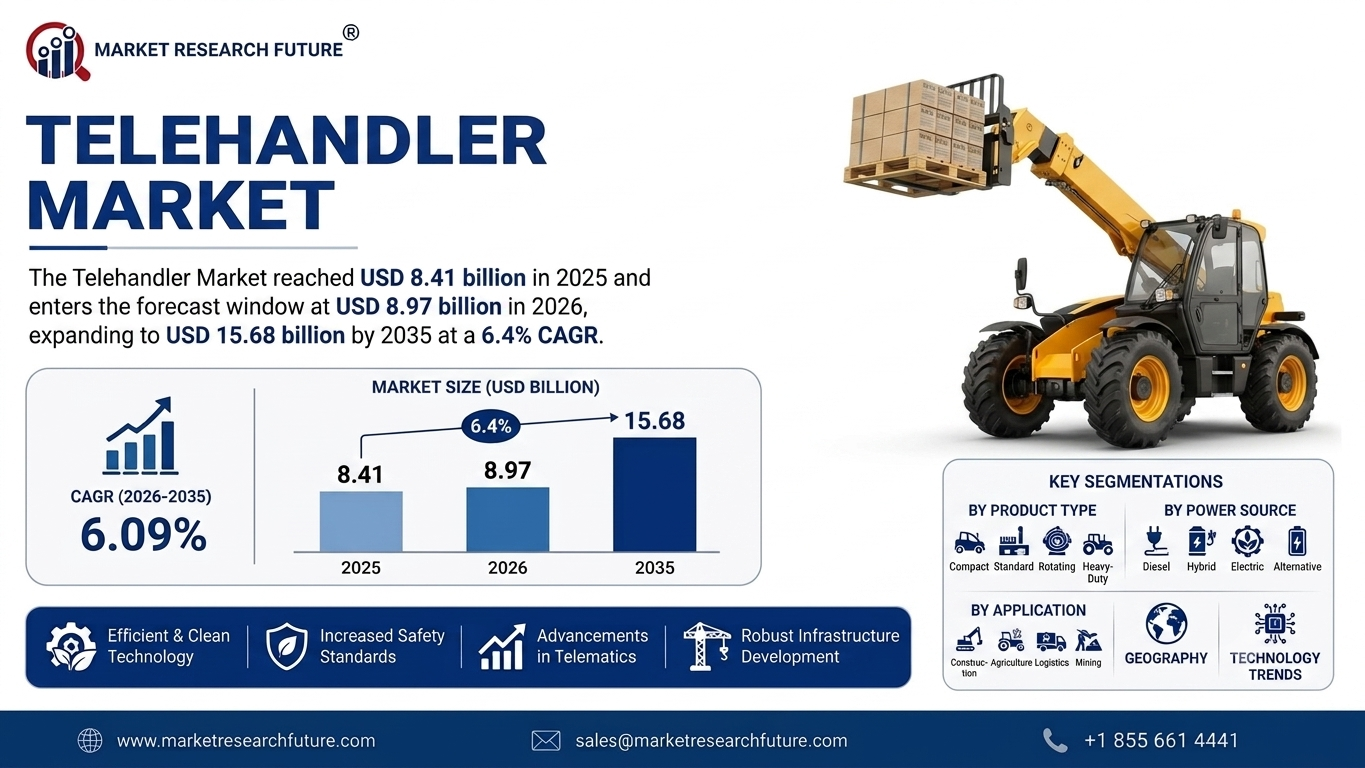
TX, UNITED STATES, September 4, 2026 /EINPresswire.com/ — The global Telehandler Market is gaining momentum as construction, agriculture, logistics, infrastructure, and industrial material-handling operations increasingly require versatile lifting equipment. According to the latest Market Research Future Telehandler Market report, the market reached USD 8.41 billion in 2025 and is projected to reach USD 15.68 billion by 2035, expanding at a 6.4% CAGR from 2026 to 2035. The market is expected to reach approximately USD 8.97 billion in 2026.
Telehandlers combine the lifting capability of forklifts with the reach and mobility of telescopic-boom equipment. Their ability to operate across uneven terrain, reach elevated work areas, and handle different attachments makes them valuable across diverse industries. Increasing infrastructure spending, agricultural mechanization, rental fleet expansion, emissions regulations, electrification, and logistics development are creating new opportunities for manufacturers.
Infrastructure Spending Drives Telehandler Market Growth
Public infrastructure investment is one of the strongest catalysts for the Telehandler Market. Large transportation, energy, utility, rail, and construction programs require material-handling equipment capable of operating across demanding jobsites.
The latest MRFR analysis identifies public infrastructure spending cycles as the leading growth driver, with an estimated 1.4% impact on CAGR. North America, Asia-Pacific, and the Middle East & Africa are particularly important markets for infrastructure-related demand.
Infrastructure projects frequently require lifting and positioning materials around bridges, roads, substations, rail corridors, and utility-scale developments. Telehandlers can provide a flexible solution where conventional forklifts have limitations because of terrain, reach, or jobsite conditions.
Continued infrastructure modernization is therefore expected to create steady replacement and new-equipment demand through the forecast period.
Construction Remains the Largest Application
Construction accounted for USD 3.53 billion in Telehandler Market revenue in 2025, making it the largest application category. Telehandlers are widely used for moving pallets, construction materials, structural components, roofing materials, and other loads around active jobsites.
The equipment’s telescopic boom provides operators with greater reach compared with conventional material-handling equipment. Its rough-terrain capability also makes it suitable for unfinished construction sites.
Urban development, commercial construction, infrastructure projects, and industrial facilities are expected to continue supporting demand. Compact telehandlers are particularly useful in urban projects where limited working space creates challenges for larger machines.
Compact Telehandlers Gain Popularity
Compact telehandlers accounted for 38.8% of market revenue in 2025, making them the leading product category. Their popularity is linked to demand from low-clearance urban construction sites, agricultural operations, and applications where maneuverability is more important than maximum lifting capacity.
Compact machines can provide a practical balance between lifting performance and jobsite mobility. They are increasingly attractive for contractors operating in dense environments where access restrictions can limit the use of conventional equipment.
The market is also seeing increasing interest in smaller electric platforms. These machines can be particularly useful for indoor applications and locations where emissions and noise restrictions limit conventional diesel equipment.
Download Report Sample Copy with TOC: https://www.marketresearchfuture.com/sample_request/2564
Rotating Telehandlers Represent a Fast-Growing Segment
Rotating telehandlers are projected to grow at a 7.7% CAGR through 2035, making them the fastest-growing product type in the current MRFR forecast.
Rotating configurations can provide greater flexibility on complex jobsites because the turret and telescopic boom allow operators to position loads without repeatedly repositioning the entire machine.
This capability is particularly relevant to dense urban construction, façade renovation, and projects where equipment footprint and maneuverability are critical.
As construction sites become more constrained and contractors seek multifunctional equipment, rotating telehandlers can gain additional market share.
Logistics and Industrial Material Handling Creates New Demand
Although construction remains the largest application, logistics and industrial material handling is forecast to grow at a 9.0% CAGR, making it the fastest-growing application category.
The expansion of warehouses, distribution centers, industrial facilities, and outdoor storage yards is creating demand for equipment capable of moving loads across mixed surfaces.
Telehandlers can operate between conventional warehouse and construction equipment roles, particularly where outdoor yards or uneven staging areas make traditional forklifts less suitable.
Growth in e-commerce infrastructure and distribution capacity is expected to support this opportunity. Manufacturers that optimize telehandlers for logistics applications can access demand beyond the traditional construction market.
Agricultural Mechanization Supports Long-Term Growth
Agriculture represents another important end-use market. The MRFR report identifies agricultural mechanization economics as a major growth driver, contributing approximately 1.1 percentage points to CAGR.
Telehandlers are increasingly used on modern farms for moving bales, feed, pallets, bulk materials, and other loads. Their ability to operate across uneven agricultural terrain provides advantages over conventional forklifts.
Agricultural labor costs are also encouraging mechanization in developed markets. The report notes that agriculture represented approximately 24.1% of application share, with rising farm labor costs across Western Europe supporting demand.
Future agricultural demand will increasingly depend on machine versatility, operating efficiency, attachment compatibility, and total cost of ownership.
Rental Services Reshape Equipment Purchasing
The growth of rental services is changing how contractors access telehandlers. Rather than purchasing equipment outright, many businesses prefer rental arrangements that reduce capital expenditure and provide access to newer machines.
The MRFR report identifies rental-led fleet deployment as a major market driver, with an estimated 1.0% impact on CAGR. In North America, rental accounts for roughly 55% of construction equipment operating on active sites.
Rental companies typically prioritize residual value, service-network coverage, parts availability, reliability, and utilization rates. This encourages manufacturers to develop equipment with standardized components, strong uptime performance, and connected fleet-management capabilities.
Rental penetration can therefore support both new-unit sales and replacement cycles as fleet operators refresh equipment.
Purchase Now: https://www.marketresearchfuture.com/checkout?currency=one_user-USD&report_id=2564
Emissions Regulations Accelerate Fleet Replacement
Environmental regulations are becoming an increasingly important demand mechanism. Older diesel machines are gradually being replaced by newer Stage V and Tier 4 Final-compliant equipment, hybrids, and electric telehandlers.
The report estimates emissions regulation and fleet retirement contribute approximately 0.9 percentage points to CAGR.
European cities and construction projects are increasingly introducing low-emission requirements, encouraging contractors to replace older equipment sooner than would otherwise be necessary.
This regulatory shift creates opportunities for manufacturers that can offer machines combining regulatory compliance with strong productivity and operating economics.
Electrification Transforms Telehandler Technology
Electrification is moving from a niche development toward an important part of the industry’s product strategy. The report identifies electrification and battery-cost declines as contributing approximately 0.8 percentage points to CAGR.
Battery-electric telehandlers are particularly attractive for applications where emissions and noise must be minimized. Indoor demolition, urban construction, municipal projects, agricultural buildings, and low-emission zones are potential areas of adoption.
Manufacturers are increasingly investing in battery platforms, charging technologies, and electric drivetrains. This transition is expected to expand as battery economics improve and customers place greater emphasis on total cost of ownership.
However, diesel machines are likely to remain important for remote and high-utilization applications where charging infrastructure is limited.
Telematics Improves Fleet Efficiency
Telematics is becoming an increasingly important differentiator in the Telehandler Market. Connected machines can provide information on utilization, operating hours, fault conditions, idle time, maintenance requirements, and location.
The MRFR report estimates telematics and uptime-based procurement contribute approximately 0.6 percentage points to CAGR.
Rental companies and large contractors can use this information to improve fleet utilization and schedule preventive maintenance. Manufacturers can also develop recurring revenue opportunities through software, monitoring, service agreements, and uptime-based contracts.
As procurement decisions shift from equipment specifications toward lifecycle performance, telematics can become an increasingly important competitive factor.
Attachment Ecosystems Increase Machine Versatility
One of the advantages of telehandlers is their ability to work with multiple attachments. Buckets, grapples, sweepers, jibs, man platforms, and agricultural attachments can expand the number of tasks performed by a single machine.
This improves fleet utilization and allows rental companies to offer multifunctional equipment without maintaining separate machines for every task.
Attachment recognition and integrated machine-control systems can further improve operational efficiency. As customers increasingly evaluate equipment based on productive hours rather than basic machine specifications, attachment ecosystems can become an important differentiator.
North America Leads the Global Market
North America accounted for 33.2% of global Telehandler Market revenue in 2025, making it the largest regional market. The region benefits from extensive construction activity, established rental channels, infrastructure spending, and mature equipment distribution networks.
The strong rental market is particularly important because rental companies represent major equipment purchasers and maintain recurring replacement cycles.
The United States remains the central regional market, supported by infrastructure investment and construction activity. Canada also contributes to demand through construction, infrastructure, agriculture, and industrial applications.
The combination of mature rental infrastructure and replacement demand should help North America maintain a strong market position throughout the forecast period.
Asia-Pacific Emerges as the Fastest-Growing Region
Asia-Pacific is projected to grow at a 7.7% CAGR through 2035, making it the fastest-growing regional market. Rapid urbanization, infrastructure development, industrial expansion, logistics investment, and agricultural mechanization are supporting demand.
India is an important opportunity because of its large infrastructure pipeline and growing construction activity. Southeast Asian markets are also benefiting from industrial development and expanding logistics infrastructure.
The region offers significant long-term potential because telehandler penetration remains comparatively low across many emerging markets. Manufacturers that combine localized distribution, financing solutions, spare-parts availability, and operator training can strengthen their position.
Middle East & Africa Benefit from Large Infrastructure Projects
The Middle East & Africa region is creating additional opportunities through large-scale infrastructure and construction programs. The current MRFR report values the regional market at approximately USD 0.42 billion, with Gulf giga-projects providing much of the incremental demand.
Large developments involving tourism, transportation, energy, utilities, commercial construction, and urban infrastructure require versatile lifting equipment.
Saudi Arabia and other Gulf markets are particularly important because large projects often require specialized machinery capable of handling materials across expansive and complex worksites.
Equipment suppliers can benefit by developing strong regional dealer networks and parts infrastructure while providing financing and technical support.
Major Challenges Facing the Market
Despite favorable growth prospects, the Telehandler Market faces several restraints. Steel and hydraulic component cost volatility can pressure manufacturers because booms, chassis, hydraulic cylinders, and other components represent significant production costs. MRFR estimates approximately 0.7 percentage points of negative CAGR impact from this factor.
Another challenge is residual-value uncertainty during electrification. Rental companies rely heavily on predictable resale values when calculating fleet economics, while the secondary market for used electric telehandlers is still developing.
The shortage of certified operators is also a concern. Specialized lifting operations require trained personnel, and labor shortages can prevent contractors from fully utilizing equipment fleets.
High acquisition costs can further limit adoption in price-sensitive emerging markets, where contractors may choose less expensive alternatives when jobsite requirements allow.
Finally, charging infrastructure remains a challenge for battery-electric telehandlers operating on remote construction, rail, pipeline, and utility projects.
Competitive Landscape
The global Telehandler Market includes major construction-equipment manufacturers competing through product innovation, rental relationships, electrification, telematics, attachments, and dealer networks.
Key companies identified by MRFR include JCB, Manitou Group, Caterpillar, Doosan Bobcat, Merlo, and Liebherr.
Competition is increasingly moving beyond lifting capacity and machine specifications. Manufacturers are investing in electric and hybrid drivetrains, operator-assistance systems, connected equipment, automated functions, and improved attachment compatibility.
Strong aftermarket service networks are also critical because rental fleets and major contractors place significant value on machine uptime, parts availability, and predictable maintenance costs.
Future Opportunities in Electric Compact Platforms
Battery-electric compact telehandlers represent one of the most promising opportunities in the market. Smaller machines can operate in environments where diesel emissions and noise create restrictions.
Potential applications include indoor construction, demolition, agricultural buildings, food-related facilities, municipal operations, and urban projects.
As battery technology improves and charging systems become more accessible, electric machines are expected to expand beyond specialized applications. The strongest early opportunities are likely to remain duty cycles with predictable operating hours and access to reliable charging.
Automation and Assisted Operation Gain Importance
Automation is expected to influence the future development of telehandlers, although fully autonomous machines are likely to remain limited to controlled environments.
Operator-assistance technologies such as load-moment monitoring, automated boom sequencing, return-to-position functions, object detection, and machine-control systems can improve productivity and reduce operator error.
These systems can also help address operator shortages by simplifying complex tasks and providing additional safety information.
The market is therefore likely to move toward assisted and semi-autonomous operation, especially in higher-specification machines.
Related Report
Heavy Duty Telehandler Market https://www.marketresearchfuture.com/reports/heavy-duty-telehandler-market-2452
Light Duty Telehandler Market https://www.marketresearchfuture.com/reports/light-duty-telehandler-market-2270
Heavy-Duty Telehandler Machines Market https://www.marketresearchfuture.com/reports/heavy-duty-telehandler-machines-market-10870
US Telehandler market https://www.marketresearchfuture.com/reports/us-telehandler-market-20493
Overall Telehandlers Market https://www.marketresearchfuture.com/reports/overall-telehandlers-market-68355
Telehandler & Backhoe Loader Market https://www.marketresearchfuture.com/reports/telehandler-backhoe-loader-market-68366
Market Research Future
Market Research Future
+1 855-661-4441
email us here
Legal Disclaimer:
EIN Presswire provides this news content “as is” without warranty of any kind. We do not accept any responsibility or liability
for the accuracy, content, images, videos, licenses, completeness, legality, or reliability of the information contained in this
article. If you have any complaints or copyright issues related to this article, kindly contact the author above.

Media gallery