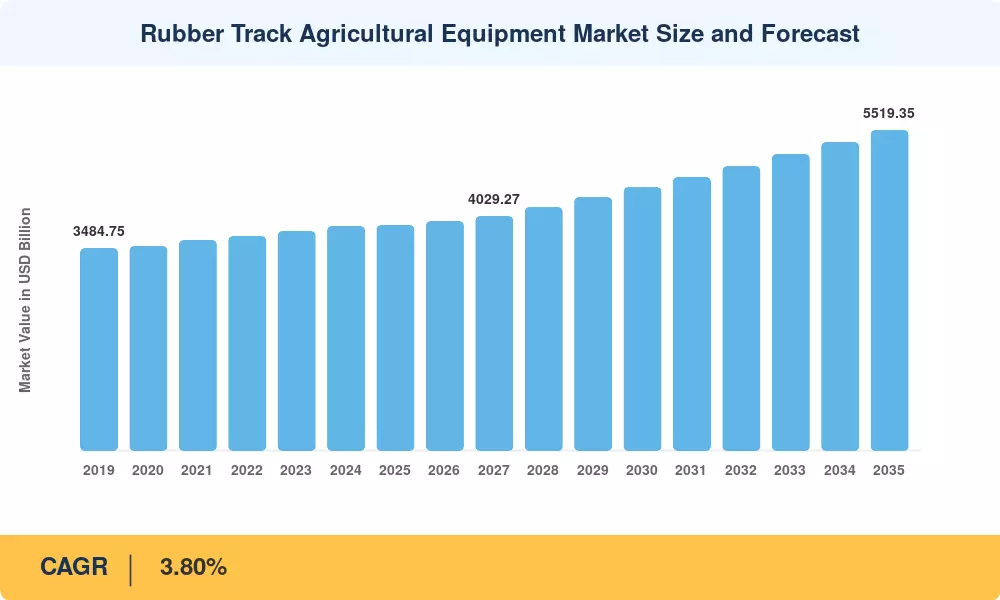
The global rubber track agricultural equipment market was valued at approximately USD 3,884.27 million in 2025
NEW YORK, NY, UNITED STATES, July 27, 2026 /EINPresswire.com/ — The global rubber track agricultural equipment market was valued at approximately USD 3,884.27 million in 2025 and is projected to reach USD 5,519.35 million by 2035, expanding at a compound annual growth rate (CAGR) of 3.80% during the forecast period of 2026–2035.
Market Overview
Rubber track agricultural equipment refers to a range of mechanized farming machinery equipped with continuous or segmented rubber track undercarriage systems instead of traditional wheels or steel tracks. These systems consist of reinforced rubber belts with internal reinforcing cords and steel cables, designed to provide superior flotation and traction across various field conditions. The technology is widely deployed across tractors, harvesters/combines, sprayers, loaders, and other specialized agricultural equipment, offering significant advantages in reducing soil compaction, improving traction, and enabling operations in challenging terrains where conventional wheeled machinery would be impractical or damaging.
The market’s upward trajectory is underpinned by several powerful catalysts. Structural demand for high-efficiency, low-maintenance undercarriage systems in off-road agricultural machinery is a primary driver, as commercial farms seek to minimize lifecycle maintenance expenses while maximizing field-operational uptime. The rising adoption of rubber track platforms to enhance traction and reduce soil compaction within precision farming operations is another key factor, with rubber tracks maintaining root-zone health in nearby crop rows by distributing machine weight over a greater contact area. The sustained expansion of mechanized farming into regions characterized by challenging terrain conditions—including wetland, hillside, and marginal soils—is further driving demand.
Industry trends indicate a decisive shift toward track-based mobility in modern agriculture. Investment in advanced land preparation and crop management technologies continued to accelerate through 2025, as original equipment manufacturers (OEMs) introduced electric drive powertrains, autonomous guidance capabilities, and expanded sprayer platforms designed for large-scale field operations, collectively reinforcing the shift toward track-based mobility. The convergence of track-based machinery with digital and electrified farming systems is highlighted by significant industry developments in early 2026, such as Caterpillar’s introduction of the Cat D8 XE dozer with an electric drive powertrain and New Holland’s introduction of the Defensor 4000 sprayer with precision agriculture integration.
Technological developments are rapidly expanding the market’s capabilities. The integration of electric and hybrid drive systems into tracked agricultural platforms is accelerating, with Caterpillar’s March 2026 launch of the Cat D8 XE electric-drive dozer marking an early turning point for electrified track-based machinery. Advancements in material science are anticipated to increase rubber track life by 20–30% through reinforced polymer compounds and embedded wear sensors enabling predictive replacement scheduling. The development of autonomous and semi-autonomous agricultural machinery is increasing, with rubber track platforms serving as the preferred mobility solution due to their stability and programmable path-tracking accuracy.
Policy and regulatory influence on the market is growing, particularly in Europe and North America. The European Union’s Soil Monitoring Law, part of the EU’s broader environmental strategy, encourages or requires low-compaction equipment practices. The US Department of Agriculture’s expanded Conservation Stewardship Program similarly incentivizes adoption of soil-protecting technologies. Sustainability-linked agricultural finance instruments, including carbon-credit-linked lease structures and green equipment loans, are expected to further accelerate adoption by reducing the effective cost premium of rubber track systems.
📍 Get Free Sample Report for Detailed Market Insights:
https://www.marketresearchfuture.com/sample_request/68392
Market Segmentation
By Equipment Type
The market is segmented by equipment type into Tractors, Harvesters/Combines, Sprayers, and Loaders & Others. Rubber-track-equipped tractors continue to be the market’s dominant equipment segment, accounting for the biggest revenue share at approximately 45% of total revenue in 2025 (USD 1,747.92 million). High-horsepower track tractors in the 300–600 HP range are the principal demand driver, favored for row-crop, broadacre, and mixed-use farming operations across developed agricultural markets. Sprayers are the fastest-growing equipment segment, with a projected CAGR of 4.50%, reflecting the expansion of large self-propelled sprayer platforms equipped with rubber tracks for improved stability and reduced crop-row damage during in-season application passes. Harvesters/combines represent USD 971.07 million in 2025, driven by grain and oilseed harvesting on heavy soils.
By Track Type
Track type segmentation covers Continuous Rubber Tracks and Segmented Rubber Tracks. Continuous rubber tracks constitute the dominant track-type segment, representing approximately 62% of the market in 2025 (USD 2,408.25 million). Their prevalence reflects OEM specification as standard equipment on high-horsepower tracked tractors and combine harvesters, where continuous track belts provide the smoothest ride, lowest ground pressure, and most consistent power transmission. Segmented rubber tracks are the faster-growing sub-segment at a CAGR of 4.20%, driven by increasing demand in retrofit and aftermarket applications where existing wheeled equipment is converted to track configurations, as well as by the growing availability of modular segmented-track systems for compact and specialty machinery.
By Application
Application segmentation includes Crop Farming, Viticulture & Horticulture, Grassland & Pasture Management, and Wetland & Specialty Farming. Crop farming is the largest application segment, accounting for 55% of market revenues in 2025 (USD 2,136.35 million), driven by the fundamental alignment between rubber track capabilities and the operational requirements of large-scale grain, corn, soybean, and cotton production. Wetland and specialty farming is the fastest-growing application segment, projected at a 4.80% CAGR, reflecting expanding rubber track adoption in rice-paddy operations across Asia-Pacific, peatland farming in Northern Europe, and environmentally regulated wetland agriculture where minimal soil disturbance is a regulatory requirement. Viticulture and horticulture represent USD 776.85 million, with narrow-gauge rubber track platforms reducing root-zone compaction between crop rows in hillside vineyards and orchards.
By End-User
End-user segmentation covers Large-Scale Commercial Farms, Small & Medium Farms, and Agricultural Service Contractors. Large-scale commercial farms represent the dominant end-user segment at 50% of 2025 revenue (USD 1,942.14 million), reflecting the capital-intensive nature of rubber track equipment and its alignment with fleet-management strategies employed by operations exceeding 1,000 hectares. Agricultural service contractors constitute the fastest-growing end-user segment at a CAGR of 4.40%, as the contractor model enables smallholder and medium-scale farms to access track-based equipment without the full capital outlay of ownership.
By Region
Regional segmentation includes North America, Europe, Asia Pacific, South America, and the Middle East and Africa. Europe led with USD 1,359.49 million in 2025. North America is the fastest-growing region at a CAGR of 4.30%. Asia Pacific represents USD 854.54 million.
🛒 You can buy this market report at:
https://www.marketresearchfuture.com/checkout?currency=one_user-USD&report_id=68392
Regional Analysis
Europe
Europe maintained its position as the leading regional market in 2025, commanding the biggest share of worldwide revenues at USD 1,359.49 million, driven by widespread mechanized farming and strict soil health rules that encourage low-compaction track systems. Germany represents the largest national market at USD 299.09 million, supported by a dense network of OEM dealerships, a strong tradition of high-horsepower tractor ownership, and a farming sector that has embraced controlled-traffic farming. France follows at USD 244.71 million, driven by broadacre crop farming and cooperative equipment procurement. The United Kingdom contributes USD 203.92 million, with controlled-traffic farming and post-Brexit agricultural investment supporting demand. Italy accounts for USD 163.14 million, driven by vineyard and orchard mechanization. The European Union’s Common Agricultural Policy (CAP) reform cycle continues to incentivize soil-protection measures through eco-scheme conditionality and direct-payment linkages.
North America
North America is the fastest-growing regional market with a projected CAGR of 4.30% over the forecast period, driven by widespread precision agriculture use in the US and Canada, as well as rising replacement demand for rubber track systems in the Midwest grain belt. The United States accounts for approximately 72% of regional revenues at USD 783.07 million, driven by replacement demand where rubber track tractors and combines have become the standard configuration for corn and soybean operations on heavy soils. Canada contributes USD 217.52 million, supported by Prairie crop farming and government clean-technology equipment rebates. Mexico accounts for USD 87.01 million, driven by irrigated-agriculture expansion and mechanization investment in northern states. The convergence of precision agriculture adoption and autonomous-readiness requirements is accelerating fleet modernization across large commercial farms.
Asia-Pacific
Asia-Pacific represents the third-largest regional market at USD 854.54 million and is projected to grow at a 4.00% CAGR through 2035, underpinned by government-sponsored mechanization programs in China and India, expanding wetland and paddy farming acreage, and the maturation of compact tracked equipment segments in Japan. China accounts for USD 299.09 million, driven by government mechanization subsidies and rice-paddy tracked harvester demand. Japan contributes USD 188.00 million, with compact tracked equipment and an aging farmer population driving automation. India represents USD 153.82 million, supported by smallholder mechanization schemes and wetland rice cultivation expansion. Australia accounts for USD 102.55 million, driven by controlled-traffic farming and broadacre grain and cotton operations.
Rest of the World
The Rest of the World segment, encompassing South America and the Middle East and Africa, presents developing market opportunities. South America’s market is driven principally by Brazil (USD 186.45 million) and Argentina (USD 108.76 million), where the extension of row-crop cultivation into cerrado and transition-zone soils has increased demand for rubber track equipment capable of mitigating compaction in dense clay substrates. Brazil accounts for nearly half of regional revenues, supported by a mature agricultural finance ecosystem. The Middle East & Africa region represents the smallest market by revenue at USD 194.21 million, supported by government-led food-security and land-reclamation programs in the Gulf states and expanding commercial farming operations in South Africa, Kenya, and Ethiopia. Saudi Arabia’s Vision 2030 program includes significant investment in irrigated agriculture, where tracked equipment is valued for its ability to operate on sandy and reclaimed desert substrates.
Competitive Landscape / Key Players
The global rubber track agricultural equipment market exhibits a moderately concentrated competitive structure, with the top five companies accounting for an estimated 64.4% of market revenue in 2025. Key companies operating in this market include CNH Industrial N.V. (19.4% share), AGCO Corporation (15.5%), John Deere (14.4%), CLAAS KGaA mbH (9.7%), and Rheinmetall AG (5.4%). Other significant players include New Holland, Caterpillar Inc., Rostselmash, Versatile-ag, and Peterburgsky Traktorny Zavod JSC.
Strategic developments in the market include significant product launches and technology partnerships. In February 2026, New Holland officially introduced its updated Defensor self-propelled sprayer line with the flagship Defensor 4000 model featuring a 4,000-liter tank capacity and advanced precision agriculture technologies. In March 2026, Caterpillar Inc. introduced the Cat D8 XE dozer with an innovative high-drive electric drive powertrain engineered to improve fuel efficiency by up to 10% and reduce maintenance costs by up to 15%. In January 2026, Caterpillar announced an expanded strategic collaboration with NVIDIA to integrate advanced physical AI and next-generation robotics infrastructure across its heavy machinery portfolios.
.
Latest Industry News & Developments
Recent industry developments highlight the ongoing transformation of the rubber track agricultural equipment market toward electrification, digital integration, and precision agriculture. In February 2026, New Holland introduced its updated Defensor self-propelled sprayer line with the flagship Defensor 4000 model engineered for large-scale field operations. The Defensor 4000 features a 4,000-liter tank capacity, stainless steel boom structure, and advanced precision agriculture technologies integrated via the IntelliView 12 monitor, including IntelliTurn automated headland maneuvers and IntelliSpray II pulse-width modulation for individual nozzle control.
In March 2026, Caterpillar Inc. introduced the Cat D8 XE dozer, featuring an innovative high-drive electric drive powertrain engineered to improve fuel efficiency by up to 10% and reduce maintenance costs by up to 15% compared to conventional mechanical alternatives. The electric drive system utilizes a Cat C15 engine to drive a generator powering an electric motor, eliminating the conventional mechanical transmission and providing constant power to the ground.
In January 2026, at CES 2026, Caterpillar Inc. announced an expanded strategic collaboration with NVIDIA to integrate advanced physical AI and next-generation robotics infrastructure across its heavy machinery portfolios. The initiative leverages the NVIDIA Jetson Thor platform for real-time edge computing, sensor-fusion navigation, and computer vision, paving the way for autonomous fleets and the newly debuted conversational Cat AI Assistant.
Market Challenges & Opportunities
Key restraints facing the rubber track agricultural equipment market include the higher upfront cost of rubber track systems compared with steel undercarriages, with OEM list prices for full-track conversion kits usually 30–50% higher than similar wheeled axle arrangements. In price-sensitive markets, this cost gap is the biggest obstacle to adoption. Limited availability of region-specific service infrastructure for track sizing and refurbishment is a constraint in many emerging-market regions where service infrastructure is underdeveloped. Wear and replacement frequency impacts are significant in highly abrasive soil conditions, where rubber track replacement intervals may be compressed to 1,500–2,500 operating hours, increasing total operating costs.
Emerging opportunities in the market are substantial and diverse. The increasing use of rubber tracks in niche agricultural applications, including orchards, vineyards, wetland rice farming, and high-value horticulture activities, could add USD 250–400 million in market value by 2035. Investment in digital infrastructure and integrated precision platforms presents a significant opportunity, with equipment platforms providing seamless digital integration fetching higher prices and better customer retention rates. Workforce development and simplified operational systems present an opportunity for manufacturers to develop operator-friendly control systems that reduce the training burden associated with track-based machinery, particularly as the agricultural labor force ages.
Future potential lies in the integration of AI and autonomous technology, with autonomous and semi-autonomous agricultural machinery increasingly using rubber track platforms as the preferred mobility solution.
To explore more market insights, visit us at:
https://www.marketresearchfuture.com/reports/rubber-track-agricultural-equipment-market-68392
Final Market Summary
The rubber track agricultural equipment market is positioned for steady growth through 2035, driven by structural demand for high-efficiency undercarriage systems, rising adoption in precision farming, and expansion of mechanized farming into challenging terrains. The projected valuation of USD 5.52 billion reflects sustained demand across tractors, harvesters, sprayers, and specialty equipment, with the market transitioning from conventional wheeled configurations to track-based mobility in modern agriculture.
The medium-term growth outlook remains positive, with the market registering a CAGR of 3.80% during the forecast period. Europe will continue to maintain market leadership through soil health compliance and advanced mechanization, while North America emerges as the fastest-growing region driven by precision agriculture adoption and fleet modernization. The ongoing development of electric drive systems, AI integration, and sustainable materials will continue to expand market possibilities and applications.
Long-term industry potential extends beyond the current forecast horizon. Electrification and autonomous machinery integration will reshape equipment capabilities, with full-electric and hydrogen fuel cell-powered tracked tractors expected to begin pre-commercial testing by 2029–2031. Regulatory and sustainability-driven shifts will accelerate adoption through expanded conservation programs and sustainability-linked agricultural finance.
More Related Reports from MRFR Library:
Polyfluoroalkyl Substances Waste Management Market: https://www.marketresearchfuture.com/reports/polyfluoroalkyl-substances-waste-management-market-23479
Screw Jacks Market: https://www.marketresearchfuture.com/reports/screw-jacks-market-23536
Industrial Valves Actuators Market: https://www.marketresearchfuture.com/reports/industrial-valves-actuators-market-23568
Precision Tool Market: https://www.marketresearchfuture.com/reports/precision-tool-market-23600
Process Control Automation Market: https://www.marketresearchfuture.com/reports/process-control-automation-market-23601
Industrial Machinery Repair Service Market: https://www.marketresearchfuture.com/reports/industrial-machinery-repair-service-market-24636
Special Interest Tourism Market: https://www.marketresearchfuture.com/reports/special-interest-tourism-market-24780
Stainless Steel Welded Pipe Market: https://www.marketresearchfuture.com/reports/stainless-steel-welded-pipe-market-25036
Fans And Blower Market: https://www.marketresearchfuture.com/reports/fans-and-blower-market-25093
Fine Bubble Diffuser Market: https://www.marketresearchfuture.com/reports/fine-bubble-diffuser-market-25105
Larry Wilson
WantStats Research And Media Pvt. Ltd.
+1 855-661-4441
email us here
Legal Disclaimer:
EIN Presswire provides this news content “as is” without warranty of any kind. We do not accept any responsibility or liability
for the accuracy, content, images, videos, licenses, completeness, legality, or reliability of the information contained in this
article. If you have any complaints or copyright issues related to this article, kindly contact the author above.

Media gallery