The Bolt-1335CRA is a 13MP color rolling shutter MIPI camera built on the Onsemi AR1335 sensor and validated specifically for the Rockchip RV1126 processor. A voice coil motor autofocus lens gives edge AI vision systems a working distance that adjusts to the application, while the RV1126’s integrated neural processing unit runs on-device inference directly adjacent to the camera pipeline without a separate compute module. Vadzo’s validation confirms the complete MIPI CSI-2 pad chain from the AR1335 sensor through the RV1126’s RKISP hardware image processor, giving OEMs a proven hardware and driver starting point rather than an open-ended integration project. Output modes span full 13MP capture down to 1080p and 720p, with autofocus control exposed through the platform’s standard camera framework. Designed for OEMs building edge AI camera systems, robotics, kiosks, drones, and industrial vision systems on Rockchip silicon, the Bolt-1335CRA gives engineering teams a camera platform that stays in focus and feeds a validated inference pipeline at the same time.
FORT WORTH, TX / ACCESS Newswire / September 17, 2026 / Vadzo Imaging, a provider of embedded vision camera products for OEMs and system integrators, today announces validation of the Bolt-1335CRA AR1335 Autofocus MIPI Camera, a 13MP color rolling shutter camera built on the Onsemi AR1335 sensor and confirmed for direct integration with the Rockchip RV1126 processor. Part of Vadzo’s MIPI camera portfolio, the Bolt-1335CRA pairs the AR1335’s voice coil motor autofocus lens with the RV1126’s on-chip neural processing unit, giving edge AI system integrators a camera that keeps a moving or variably positioned subject in focus while inference runs directly on the host processor. With this validation, Vadzo delivers a 13MP Color MIPI Camera that ships with confirmed media pipeline configuration and Linux driver packages for RV1126, giving robotics engineers, kiosk manufacturers, and drone platform integrators a camera module ready for direct integration into AI vision products without independent driver development.
Technical Problem Definition
Edge AI vision systems built around a neural processing unit depend on one assumption that is easy to overlook during system design: the inference model can only be as accurate as the frame it receives, and a soft, out-of-focus frame degrades detection and classification accuracy just as much as a low-resolution one does. Many camera modules paired with NPU-equipped SoCs like the RV1126 still ship with fixed-focus optics, which works acceptably when the subject sits at a single predictable distance but breaks down the moment an application needs to recognize objects, faces, or parts that appear at varying distances from the lens. A drone camera built on an AR1335 RV1126 Autofocus Sensor changes altitude and subject distance throughout a flight. An RV1126 Autofocus Camera Module deployed in a kiosk or robotics cell may need to recognize a subject standing close to the camera in one moment and further away in the next. A fixed focus lens calibrated for one of those distances produces a soft frame at the other, and no amount of NPU processing power downstream can recover detail that was never captured in focus in the first place. There is a second problem specific to NPU-equipped platforms. Center-weighted or full-frame autofocus algorithms, the kind built into most autofocus camera modules, focus on whatever sits in the middle of the frame regardless of where the actual subject of interest is located. When the NPU has already identified a subject’s bounding box through its own detection model, an autofocus system that ignores that information and focuses on the frame center instead can leave the actual subject of interest soft while the background behind it is sharp. OEMs building serious edge AI products need the camera’s focus behavior and the SoC’s inference output working together, not as two independent systems that happen to share a MIPI CSI-2 cable. There is a third consideration that compounds both problems: many camera modules advertised as Rockchip compatible have only been validated against a generic MIPI CSI-2 electrical specification rather than the specific RKISP configuration and media pipeline structure a given RV1126 board revision requires. Device tree node structure, MIPI lane mapping, and pad format negotiation vary enough between Rockchip SoC generations that a camera confirmed on a different Rockchip module can still require additional debugging on RV1126 specifically, leaving OEMs to absorb integration risk that a properly validated camera module should have eliminated before shipment.
Engineering Explanation
The Bolt-1335CRA addresses both problems by pairing the Onsemi AR1335 sensor with a voice coil motor autofocus lens whose control path is validated end-to-end against the Rockchip RV1126’s camera subsystem. The RV1126 combines a quad-core ARM Cortex-A7 CPU, a dedicated neural processing unit rated near two trillion operations per second, and Rockchip’s RKISP hardware image signal processor in a single low-power SoC package built specifically for edge AI vision workloads. Vadzo confirms the complete MIPI CSI-2 pad chain from the AR1335 sensor subdevice, through the RV1126’s CSI-2 receiver, into the RKISP processing pipeline, and out to the video device node that application software reads frames from. This differs meaningfully from validating against a generic MIPI CSI-2 electrical specification, since RKISP tuning parameters, lane configuration, and pad format negotiation are all specific to the RV1126’s camera subsystem implementation rather than portable from a different Rockchip SoC without modification. On the autofocus side, the voice coil motor lens assembly exposes its control interface through the platform’s standard camera framework, so application software running on the RV1126’s NPU can pass a detected subject’s bounding box coordinates back to the autofocus control loop rather than the lens defaulting to a center-weighted or full-frame contrast measurement. This lets an AR1335 NPU Autofocus Sensor use its own detection output to drive where the camera focuses, closing the loop between what the NPU has identified as the subject of interest and what the lens actually renders sharp. An RV1126 Color Autofocus Camera built this way produces meaningfully better downstream classification accuracy than a camera and NPU pairing that treat focus and inference as unrelated subsystems, since the frame the NPU analyzes on subsequent cycles is now sharp specifically where the subject sits rather than sharp only at the frame center. The camera connects over a MIPI CSI-2 interface, providing sufficient bandwidth for full 13MP capture at frame rates appropriate for still analysis, with 4K, 1080p, and 720p downsampled modes available for higher frame rate operation when the inference workload favors frame rate over resolution. The camera is rated across a -30 degree C to 70 degree C operating range, matching the environmental envelope typical of outdoor kiosks, drone payload bays, and industrial enclosures where RV1126-based products are commonly deployed. Focus response speed matters as much as focus range for applications where the subject distance changes quickly, so Vadzo tunes the voice coil motor’s drive current profile for the frame rates typical of edge AI inference workloads rather than shipping the lens manufacturer’s default settling behavior unmodified. A slow autofocus response produces several soft frames every time a subject’s distance changes meaningfully, and those frames still consume NPU cycles for inference even though their classification confidence will be lower than a properly focused frame would deliver.
Product Overview
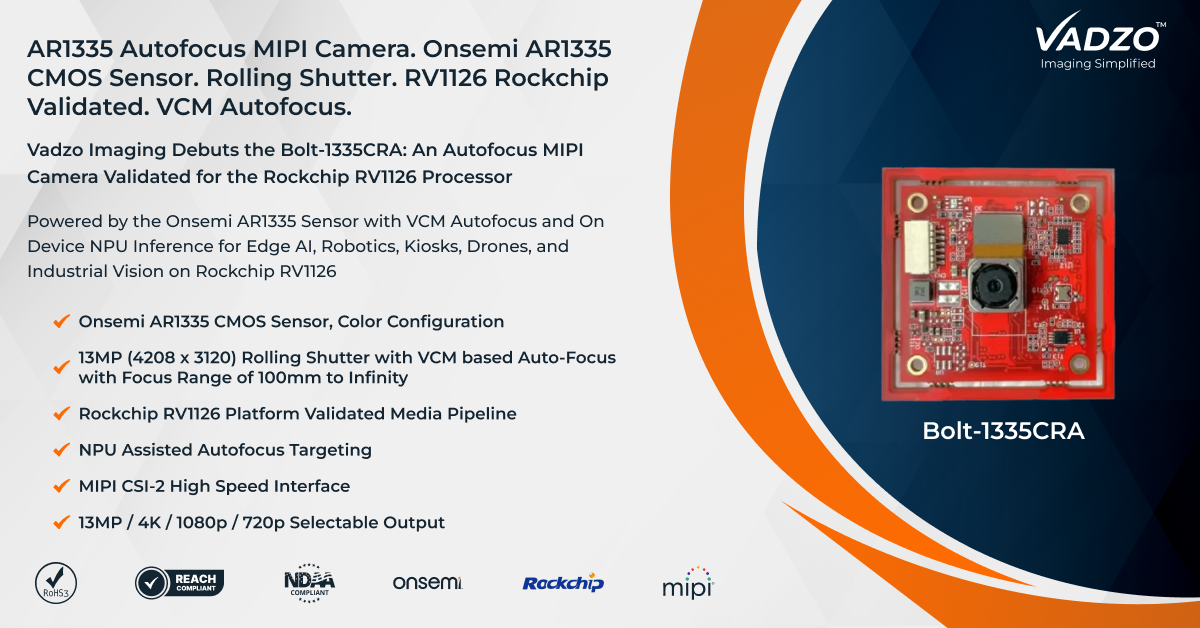
The Bolt-1335CRA is an AR1335 Autofocus MIPI Camera built on the Onsemi AR1335 sensor and paired with a voice coil motor autofocus lens validated specifically for the Rockchip RV1126 processor. As an AR1335 Rockchip Camera, it is purpose-built for OEMs who need a camera that keeps a variably positioned subject in focus without adopting a custom lens control layer for every new Rockchip platform target. The 13MP AR1335 Autofocus MIPI Camera designation reflects Vadzo’s validation process, which confirms the autofocus control path, the RKISP media pipeline configuration, and the MIPI CSI-2 timing against the RV1126’s camera subsystem before the module reaches OEM customers. The camera module houses the AR1335 sensor, ISP, autofocus lens assembly, and MIPI CSI-2 interface in a compact form factor with a standard M12 lens holder. Output modes include full 13MP, 4K, 1080p, and 720p, selectable to balance resolution against frame rate and CSI-2 bandwidth for the target inference workload. The camera integrates with the RV1126’s Linux camera stack through confirmed driver configuration, requiring no proprietary vendor software package for basic frame capture, autofocus control, or exposure control.
Key specs: 13MP (4208 x 3120) | Onsemi AR1335 1/3.2 inch 1.1-micron pixel | Color | Rolling Shutter | VCM-based Auto-Focus with Focus Range of 100mm to Infinity | MIPI CSI-2 | RV1126 Rockchip Processor | -30°C to 70°C
Key Capabilities of the Onsemi AR1335 Onsemi AR1335 Autofocus Sensor
13MP Color Resolution with Autofocus for On-Device AI Inference: Most autofocus camera modules validated for edge AI SoCs are tuned around lower resolutions to conserve NPU processing budget, which leaves fine detail on the table for applications that genuinely need it. The Bolt-1335CRA, positioned as a 13MP Rockchip MIPI Camera, captures full 13MP (4208 x 3120) color detail while its voice coil motor lens holds focus across the working distances typical of robotics, kiosk, and drone deployments. This gives OEMs building a 13MP RV1126 Autofocus Sensor deployment the resolution headroom to crop a region of interest for NPU analysis without the interpolation penalty a lower resolution sensor would introduce at the same crop ratio.
RV1126 Rockchip Platform Validation: A camera module that lists Rockchip compatibility in its datasheet has not necessarily been validated against the specific RKISP configuration, MIPI lane mapping, and media pipeline structure that a given Rockchip SoC generation requires. The Bolt-1335CRA is validated specifically as an AR1335 Rockchip Sensor Kit, with Vadzo confirming pad format negotiation, RKISP tuning, and autofocus control directly on RV1126 hardware before release. This makes it a genuine Rockchip processor camera reference design rather than a generic MIPI sensor breakout board, and Vadzo extends the same validation discipline as an RV1126 Rockchip Processor Camera across other Rockchip SoC generations in its camera lineup.
NPU Assisted Autofocus Targeting: Center-weighted autofocus algorithms assume the subject of interest sits at or near the frame center, an assumption that fails as soon as a detected object, face, or part appears off-center in the frame. The Bolt-1335CRA’s autofocus control path is exposed through the RV1126’s standard camera framework, so application software running on the platform’s neural processing unit can pass detected bounding box coordinates directly to the lens control loop. This makes the camera an AR1335 AI SoC Autofocus Sensor capable of focusing on the subject the NPU has actually identified rather than whatever happens to occupy the frame’s geometric center, closing the gap between detection output and focus behavior that a generic autofocus module leaves open. Application developers implementing this behavior send updated focus target coordinates to the lens driver whenever the detection model produces a new bounding box, so the autofocus loop tracks the subject continuously rather than re-centering on the frame middle every time the subject moves.
MIPI CSI-2 Integration for Low Power Edge AI Systems: Battery-powered and thermally constrained edge AI products need every component in the imaging pipeline to operate within a tight power budget, and a camera interface that requires an intermediate USB bridge or a separate capture card adds power draw the system cannot afford. The Bolt-1335CRA connects directly over MIPI CSI-2 to the RV1126’s CSI-2 receiver and RKISP hardware pipeline, avoiding that overhead entirely. This makes the camera well suited to an RV1126 Vision Autofocus Module deployment where every milliwatt matters, and Vadzo confirms the complete pad chain for a 13MP RV1126 Autofocus Sensor so integrators start from a validated configuration rather than deriving lane mapping properties from a generic MIPI CSI-2 datasheet. A 13MP Rockchip Autofocus Camera built on this validated pipeline reaches production integration faster than a camera module validated only against a generic electrical specification.
Machine Vision and Multi-Platform Rockchip Support: OEMs building a product line that spans multiple Rockchip SoC generations need camera hardware that behaves consistently across that range rather than requiring separate qualification for each new platform revision. The Bolt-1335CRA, evaluated as a 13MP RV1126 Rockchip MIPI Camera, gives system integrators a single hardware reference that Vadzo extends across compatible Rockchip platforms as new SoC generations become available. For AR1335 RV1126 Machine Vision deployments specifically, autofocus consistency across a product line matters as much as raw resolution, since a machine vision algorithm tuned against one camera’s focus behavior should not need retuning when an OEM migrates to a newer Rockchip module. This makes the camera a practical AR1335 SoC Embedded Vision building block for OEMs standardizing their embedded vision hardware across a multi-generation product roadmap.
OEM Integration Across Rockchip Programs: The Bolt-1335CRA ships with confirmed media pipeline configuration and Linux driver packages for RV1126, and Vadzo extends the same validation approach across its broader Rockchip camera lineup for OEMs whose product line spans multiple Rockchip generations. Available as a MIPI Autofocus Camera for RV1126 for evaluation, the camera lets engineering teams confirm autofocus behavior and RKISP image quality before committing to a production bill of materials. For OEMs evaluating Vadzo as an OEM RV1126 Autofocus Module supplier, this means lens matching, firmware customization, and enclosure design support are available alongside the core camera hardware rather than as a separate engagement. Vadzo’s track record as a Rockchip processor Camera Manufacturer and its specific experience as an RV1126 Rockchip Processor Camera Manufacturer cover production programs spanning multiple sensor families and interface types for OEM customers building edge AI vision products.
“Every edge AI team we talk to has the same two problems, and they usually treat them as separate. The first is a camera that cannot hold focus once the subject moves off a single fixed distance. The second is an autofocus system that has no idea what the NPU has already detected, so it focuses on the frame center while the actual subject of interest goes soft. The Bolt-1335CRA was built to close that gap. By validating the Onsemi AR1335 autofocus lens against the RV1126’s camera subsystem and exposing focus control through the platform’s standard framework, we give OEMs a camera that can take direction from their own detection model instead of guessing at the frame center. That is a meaningfully better foundation for a real edge AI product than treating the camera and the NPU as two systems that just happen to share a cable.” – Alwin Vincent, Product Manager, Vadzo Imaging.
Application Specific Sections
Edge AI Development Platforms: Engineering teams building a new edge AI vision product on Rockchip silicon often start from a development board before committing to a custom carrier design, and the camera they prototype with needs to behave the same way the production camera eventually will. The Bolt-1335CRA works as an RV1126 Autofocus Edge AI Camera for exactly this evaluation stage, connecting directly to standard RV1126 development board camera connectors with confirmed driver support, so engineering teams can validate autofocus behavior, RKISP image quality, and NPU integration before finalizing a production design.
Robotics and Machine Vision Guidance: Robotics platforms performing visual guidance, pick and place, or navigation need a camera that holds focus as the distance between the camera and the target object changes throughout a task cycle. The Bolt-1335CRA functions as an RV1126 Autofocus Robotics Camera for these deployments, pairing autofocus that adjusts to the current working distance with the RV1126’s on-device inference so robotics integrators can run detection and guidance algorithms directly on the camera’s host processor without a separate compute module. Fleet operators standardizing on a single camera module across multiple robot chassis avoid the qualification overhead of validating separate fixed focus variants for each vehicle’s typical working distance.
Self-Service Kiosks and Interactive Displays: Self-service kiosks running facial recognition, age verification, or interactive display logic need a camera that stays in focus as users of different heights present themselves at slightly different distances from the lens. The Bolt-1335CRA serves as an RV1126 Autofocus Kiosk Camera for this variability, combining autofocus with the RV1126’s NPU so the kiosk can both keep the user in focus and run recognition inference on the same low power SoC without a separate vision processing board.
Drone and Aerial Inspection Platforms: Drone-based inspection and mapping payloads need a lightweight, low-power camera that holds focus as altitude and subject distance change throughout a flight, since a fixed focus lens calibrated for one altitude produces soft imagery the moment the drone climbs or descends. The Bolt-1335CRA operates as an RV1126 Autofocus Drone Camera for these platforms, giving drone OEMs autofocus performance paired with the RV1126’s low-power NPU for onboard inference during flight rather than requiring a separate downlink to ground-based processing.
Industrial Automation and Inspection Systems: Industrial inspection stations increasingly run detection and classification models directly on an embedded SoC at the inspection point rather than sending raw video to a central server. The Bolt-1335CRA serves as an RV1126 Autofocus Industrial Camera for exactly this architecture, connecting directly over MIPI CSI-2 to the RV1126’s RKISP and NPU without an intermediate capture stage, and confirmed driver support reduces the integration timeline for OEMs deploying edge AI inspection systems across multiple production lines. Inspection engineers introducing a new part variant can validate detection performance on the same camera hardware already qualified for the rest of the line, rather than triggering a new camera qualification cycle every time the part catalog expands.
Frequently Asked Questions
Q: Why does Vadzo Imaging pair an autofocus camera with a Rockchip AI processor for edge vision applications?
A: Vadzo Imaging designs its Rockchip camera lineup around a principle that is easy to overlook in edge AI system design: an inference model can only analyze what the camera actually captures in focus. Vadzo Imaging validates autofocus lens assemblies specifically for Rockchip AI processors so that a detection or classification model receives a sharp frame regardless of how far the subject sits from the lens on any given cycle. Vadzo Imaging positions this pairing as a foundational requirement for reliable edge AI performance, not a convenience feature layered on afterward.
Q: How does Vadzo Imaging validate its camera modules for the Rockchip RV1126 platform specifically?
A: Vadzo Imaging confirms the complete camera pipeline directly on RV1126 hardware before a module ships, rather than relying on a generic MIPI CSI-2 electrical specification alone. This includes media pipeline configuration, image processor tuning, and autofocus lens control validated against the platform’s actual camera subsystem. Vadzo Imaging’s validation process means OEM engineering teams receive confirmed reference configuration and driver packages for RV1126 rather than a starting point that still requires independent driver development.
Q: Does Vadzo Imaging’s Rockchip camera use on-device AI to improve autofocus accuracy?
A: Yes. Vadzo Imaging exposes autofocus control on its Rockchip camera lineup through the platform’s standard camera framework, which allows application software running on the processor’s neural processing unit to direct the camera’s focus toward a specific detected subject rather than the frame center by default. Vadzo Imaging built this capability specifically because a camera and an AI processor that operate as two unrelated systems produce weaker results than a camera whose focus behavior can respond to what the AI model has actually detected.
Q: Is Vadzo Imaging’s Rockchip camera suitable for battery-powered or low-power edge AI devices?
A: Yes. Vadzo Imaging selects the Rockchip RV1126 platform for this camera lineup specifically because it combines a capable neural processing unit with a low overall power budget, and Vadzo Imaging’s camera connects directly over MIPI CSI-2 without an intermediate USB bridge or capture card that would add unnecessary power draw. This combination makes Vadzo Imaging’s Rockchip camera a practical choice for drone payloads, portable kiosks, and other battery-powered edge AI products where every milliwatt of power budget matters.
Q: Why should OEMs building Rockchip-based AI vision products choose Vadzo Imaging as their camera supplier?
A: Vadzo Imaging offers more than a validated camera module. OEMs building Rockchip-based AI vision products and working with Vadzo Imaging receive engineering support covering lens selection, firmware customization, and carrier board integration guidance alongside confirmed RV1126 driver packages. Vadzo Imaging maintains evaluation kits with no minimum order requirement, so engineering teams can confirm autofocus and inference performance on their own platform before committing to volume production. This combination of validated hardware, confirmed software support, and low minimum evaluation access is why edge AI OEMs continue to choose Vadzo Imaging for Rockchip camera integration programs.
Availability
The Bolt-1335CRA AR1335 Autofocus MIPI Camera built on the Onsemi AR1335 sensor is available now for evaluation and production orders. Evaluation kits include the camera module, autofocus lens assembly, MIPI CSI-2 flex cable, and RV1126 driver documentation, with no minimum order requirement. Browse the full RV1126 Autofocus Vision System lineup at Vadzo’s website or contact Vadzo at support@vadzoimaging.com to request an evaluation unit or discuss OEM integration requirements for edge AI, robotics, kiosk, and drone camera programs.
About Vadzo Imaging
Vadzo Imaging is a global provider of embedded vision solutions and delivers high-performance camera technologies and imaging platforms for applications in robotics, industrial automation, UAVs, edge AI, and medical systems. Its products are designed for seamless integration with leading embedded platforms including NVIDIA Jetson, Raspberry Pi, Rockchip, and NXP i.MX. Vadzo supports customers through hardware customization, firmware development, and module-level drivers, enabling faster development and deployment of vision-based systems across MIPI, USB, GigE, Wi-Fi, and SerDes camera interfaces.
Media Contact
Alwin Vincent
Vadzo Imaging
Email: alwin@vadzoimaging.com
LinkedIn: Vadzo Imaging
YouTube: Vadzo Imaging
X: Vadzo Imaging
SOURCE: Vadzo Imaging
View the original press release on ACCESS Newswire
Media gallery