Built for point-of-care diagnostics, automated slide imaging, and pathology vision systems that must resolve a specimen clearly regardless of exactly how it is presented, this camera pairs the Onsemi AR1335 monochrome sensor with VCM autofocus and an M12 lens mount over USB 3.2 Gen 1, giving medical diagnostic equipment manufacturers consistent focus without a fixed working distance assumption baked into the hardware.
FORT WORTH, TX / ACCESS Newswire / September 4, 2026 / Vadzo Imaging, a world leader of embedded vision solutions, today announced the positioning of the 13MP 1.1u pixel size Falcon-1335MRH, a AR1335 Monochrome Autofocus USB Camera built around the Onsemi AR1335 sensor for point of care diagnostics, automated slide imaging, and pathology vision applications that need consistent focus across a variable working distance.
Why Medical Diagnostics Needs an AR1335 Monochrome Autofocus USB Camera Built for Variable Working Distance
Medical and diagnostic imaging devices rarely encounter a perfectly consistent working distance in real-world clinical or laboratory use. A point of care device might be held at a slightly different distance by different operators, a slide loaded onto an automated imaging system might vary in thickness from one coverslip to the next, and a portable diagnostic device might be used across a range of clinical settings each with its own physical constraints. A fixed focus lens tuned for one assumed distance produces a soft, unreliable image the moment actual use deviates from that assumption.
An AR1335 VCM Autofocus USB Camera approaches that problem by adjusting focus electronically for each new specimen or use scenario, rather than requiring an operator to manually refocus or a manufacturer to guarantee a single fixed distance across every possible use case. An M12 Mono Camera configuration like this one also gives diagnostic equipment manufacturers the flexibility to select optics suited to a specific application, rather than committing to a fixed lens chosen for one assumed use case.
A second, related consideration is achieving that focus flexibility without sacrificing the resolution a diagnostic or research task actually requires. An AR1335 Mono Autofocus Camera addresses that balance directly, since a camera that adjusts focus well but cannot resolve fine diagnostic detail is not actually solving the underlying imaging problem.
Neither challenge exists independently in a real diagnostic deployment. A camera that adjusts focus well but resolves insufficient detail still fails a diagnostic task depending on fine structural information, and a high resolution sensor locked into a single fixed working distance still fails the moment real world use varies from that assumption. Solving both from the same sensor platform is what makes a camera genuinely suited to medical diagnostics rather than adequate on only one specification.
Engineering Explanation: Autofocus, Optics, and Resolution Together
Onsemi designed the AR1335 as a 13-megapixel monochrome sensor, and Vadzo Imaging pairs that sensor with a VCM autofocus lens assembly specifically for diagnostic and life sciences applications where working distance cannot reasonably be guaranteed to stay fixed. As an Onsemi AR1335 VCM Autofocus Camera, the sensor adjusts focus electronically across a genuine working range, giving diagnostic equipment manufacturers a single camera platform that handles both a closely held point of care device and a slide imaging system with variable specimen thickness.
That autofocus capability works alongside an M12 lens mount rather than a fixed, non-interchangeable optic. As an AR1335 M12 Mono Sensor, the Falcon-1335MRH lets equipment manufacturers select optics suited to a specific working distance or field of view, and a VCM Mono Autofocus Sensor configuration like this one combines that optics flexibility with electronic focus adjustment for a genuinely adaptable imaging platform.
Resolution and focus flexibility work together rather than as competing priorities. As a 13MP VCM Autofocus Camera, the Falcon-1335MRH resolves genuine diagnostic detail regardless of where autofocus settles within its working range, and a M12 Lens Autofocus Camera configuration like this one gives equipment manufacturers confidence that switching lenses for a different application does not sacrifice the resolution the underlying sensor provides.
USB 3.2 Gen 1 connectivity completes the design for practical diagnostic platform integration. As a 1.1 micrometre Pixel Mono Camera, the Falcon-1335MRH enumerates as a standard UVC device without a proprietary driver, giving medical diagnostic equipment manufacturers a familiar, widely supported connectivity option rather than a specialized interface that would complicate integration with existing diagnostic software.
Product Overview
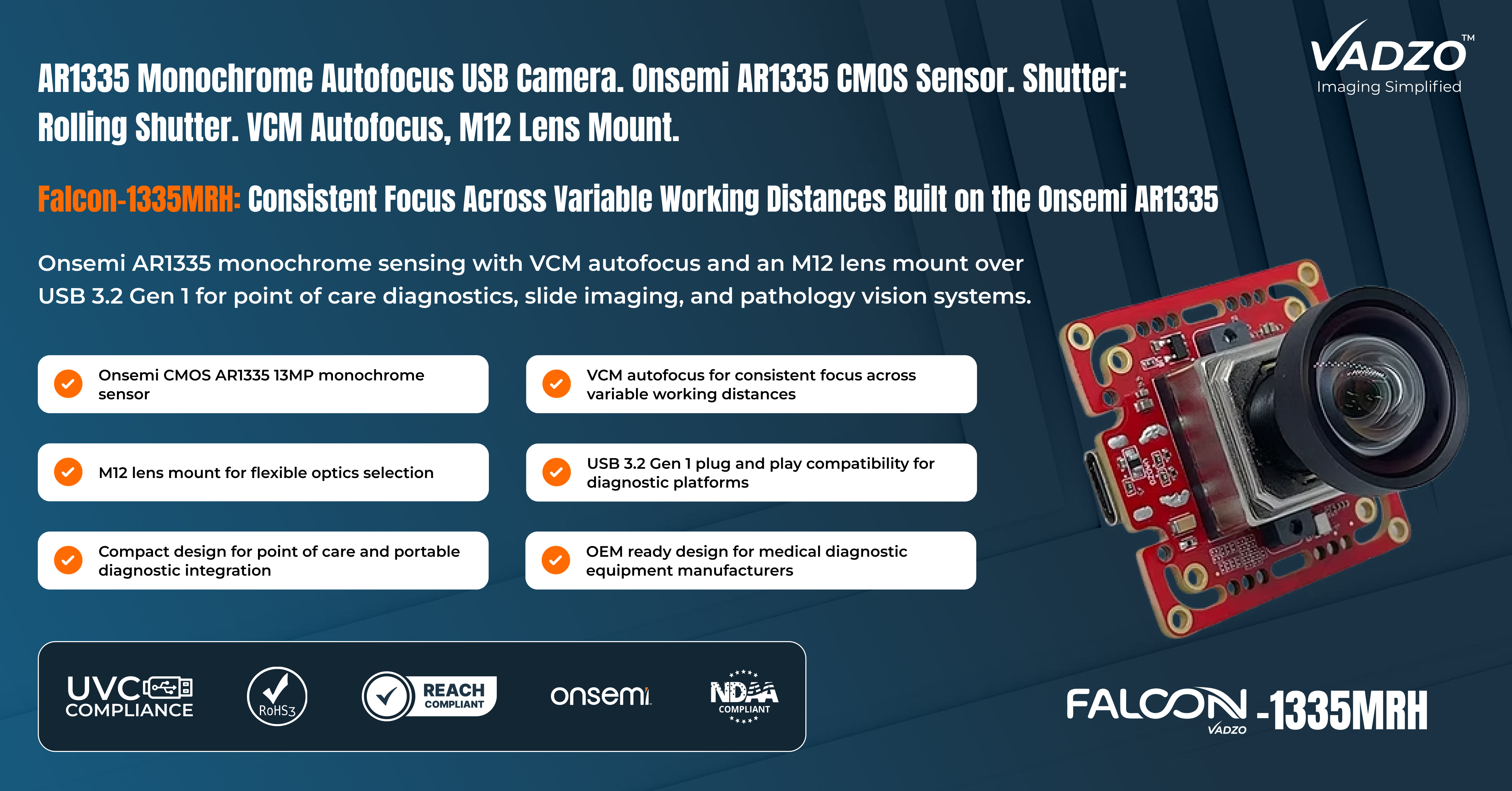
The Falcon-1335MRH pairs the Autofocus Mono Sensor Module with VCM autofocus and an M12 lens mount in a compact design suited to point-of-care, slide imaging, and pathology instrument integration. As a 13MP VCM Autofocus USB Camera, it outputs full 13 megapixel resolution with autofocus active by default, giving medical diagnostic equipment manufacturers a single camera platform that covers point of care imaging, automated slide capture, and general purpose diagnostic vision from one module.
At the core of the module sits the Variable Focus Mono Camera sensor, chosen specifically for the combination of resolution and autofocus flexibility that medical diagnostic applications require. Because the camera pairs 13MP Mono Autofocus Module focus adjustment with 4K Mono Autofocus Camera resolution, the Falcon-1335MRH reaches usable image quality across a genuinely variable working distance without requiring a fixed distance assumption at the design stage.
Product Specifications
Key specs: 13MP (4208 × 3120) Max Resolution | Onsemi AR1335, 1/3.2-inch Sensor Format | 1.1 µm Pixel | Monochrome, Rolling Shutter | USB 3.2 Gen 1 Interface | VCM Autofocus, M12 Mount Optics
Key Capabilities
Onsemi AR1335 Monochrome Sensor for Detailed 13MP Diagnostic Imaging: The Falcon-1335MRH is built around the Onsemi AR1335 sensor, a device that resolves genuine 13 megapixel detail for point-of-care, slide imaging, and pathology vision applications. This gives the module 13MP M12 Mono Sensor performance suited to diagnostic tasks that need to examine fine structural detail regardless of which specific working distance a given use case actually presents. As a 4K Autofocus Camera Module, it also fits directly into Vadzo Imaging’s broader 4K autofocus camera portfolio, and as a 13MP High Resolution USB Camera Module, it gives integrators a consistent point of comparison against other high resolution USB modules in the same product family. That portfolio consistency matters for manufacturers standardizing on a single sensor family across several diagnostic product tiers, since qualifying one platform across multiple configurations is considerably less engineering work than qualifying a different sensor for each tier.
VCM Autofocus for Consistent Focus Across Variable Working Distances: A point-of-care device rarely gets held at the exact same distance by every operator, and a slide loaded onto an imaging system rarely presents the exact same thickness from one specimen to the next. As a Focus Adjustable Lab Camera, the Falcon-1335MRH’s VCM autofocus adjusts electronically for each of these situations, keeping a specimen in focus without requiring an operator to reposition it or a technician to manually refocus between uses. As a 4K M12 Autofocus Camera, it delivers that adjustment across the sensor’s full supported focus range.
M12 Lens Mount for Flexible Optics Selection: A fixed, non interchangeable lens locks an equipment manufacturer into a single optical configuration for the life of a product, which becomes a real limitation when a platform needs to serve multiple applications with different working distance or field of view requirements. As an Autofocus Diagnostic Camera Module, the Falcon-1335MRH’s M12 lens mount lets manufacturers select optics suited to a specific application, extending the same underlying sensor across multiple diagnostic product configurations. That extension matters directly for manufacturers who want to offer both a point-of-care variant and a benchtop variant of the same underlying diagnostic platform without maintaining two entirely separate camera qualification efforts.
USB 3.2 Gen 1 Plug and Play Compatibility for Diagnostic Platforms: As an Autofocus USB Camera Module, the Falcon-1335MRH enumerates automatically on Windows, Linux, and macOS without a proprietary driver install, which matters directly for medical diagnostic equipment manufacturers building on existing diagnostic software that already expects a standard UVC device. This makes it a genuine Plug and Play Mono Autofocus option for integrators who need focus flexibility without a specialized interface or a custom capture card.
Compact Design for Point of Care and Portable Diagnostic Integration: Point of care and portable diagnostic devices are often designed around limited available space, leaving little room for a camera and its supporting electronics without a significant redesign of the enclosure. The Falcon-1335MRH’s compact design fits into that constrained space, integrating directly into existing diagnostic device hardware without requiring a custom enclosure redesign. That compatibility matters directly for manufacturers upgrading an established diagnostic product line to autofocus capability, since redesigning an enclosure across an entire product family would add real cost and regulatory recertification burden to what should otherwise be a straightforward component upgrade. Preserving an already validated enclosure design also shortens the path back through regulatory review, since the imaging component changes without disturbing the mechanical and electrical design already on file.
OEM Ready Design for Medical Diagnostic Equipment Manufacturers: Medical diagnostic equipment manufacturers producing units at scale need a camera platform that stays consistent across a long, often regulated production run, from early design validation through full scale manufacturing. Vadzo Imaging supports full customization on this platform as an Autofocus Mono Camera Supplier, including connector changes, optics selection, and firmware adjustments for manufacturers headed into volume production across multiple diagnostic product lines. That customization extends to autofocus range and speed tuning as well, since a manufacturer building a point-of-care handheld device may need a different focus profile than one building a fixed automated slide imaging system, even though both rely on the same underlying sensor.
“Point-of-care and diagnostic equipment teams keep telling us the same thing: a camera built around one assumed working distance breaks the moment real-world use varies even slightly from that assumption. The AR1335’s VCM autofocus combined with an interchangeable M12 lens mount gives the Falcon-1335MRH genuine flexibility across point of care devices, slide imaging systems, and pathology platforms, all from the same underlying sensor. We built this camera for the working distance variation a real diagnostic deployment presents, not a single controlled bench measurement.” – Alwin Vincent, Product Manager at Vadzo Imaging.
Application-Specific Sections
Point of Care Diagnostic Imaging: Point of care diagnostic devices need to resolve specimen detail reliably regardless of exactly how an operator holds or positions the device during use. As a Point of Care Autofocus Camera, the Falcon-1335MRH’s VCM autofocus supports that reliability, and functioning as a Medical Autofocus USB Module, it extends the same capability to broader point of care device integration.
Automated Slide Imaging and Scanning: Automated slide imaging systems need to maintain focus across specimens that vary in thickness from one slide to the next, often without an operator present to manually adjust focus between samples. As an Autofocus Slide Imaging Camera, the Falcon-1335MRH holds that focus automatically, and a Variable Focus Lab Camera configuration of the same module extends the same reliability to general laboratory slide handling workflows.
Pathology and Histology Vision Systems: Pathology and histology vision systems depend on consistent, high resolution imaging across every specimen examined, since inconsistent focus between samples can introduce genuine uncertainty into a diagnostic result. As an Autofocus Pathology Vision Camera, the Falcon-1335MRH supports that consistency, and a Life Science Autofocus Camera configuration of the same module extends the same reliability to broader life sciences research imaging beyond dedicated pathology tasks. That documentation consistency matters directly for regulatory and accreditation reviews, where imaging methodology and equipment reliability are often scrutinized alongside the diagnostic results themselves.
Portable and Handheld Diagnostic Devices: Portable and handheld diagnostic devices need to perform reliably across the range of distances and angles an operator might reasonably use in the field, not just a single controlled clinical setting. As an Autofocus Microscopy Camera, the Falcon-1335MRH supports that field reliability, and a Variable Focus Mono Camera configuration extends the same capability to broader portable diagnostic use cases.
OEM Integration for Medical Diagnostic Equipment Manufacturers: Medical diagnostic equipment manufacturers building their own point of care, slide imaging, or pathology hardware need a camera vendor who understands the autofocus and optics requirements those systems demand. The Falcon-1335MRH ships with those requirements built in, and Vadzo Imaging supports OEM customization for cable length, connector type, and firmware for manufacturers standardizing on one camera across multiple diagnostic product lines.
Frequently Asked Questions
Q: Why does a point of care diagnostic device need autofocus rather than a fixed focus lens?
A: A point of care device is typically held or positioned by hand rather than mounted at a fixed, guaranteed distance the way a benchtop instrument might be, and that variation in how different operators actually hold a device introduces genuine working distance variability into everyday use. A fixed focus lens tuned for one assumed distance produces a soft, unreliable image the moment an operator holds the device even slightly differently than that assumption, which is a realistic scenario rather than an edge case for a handheld diagnostic tool. The Falcon-1335MRH uses VCM autofocus specifically because point-of-care devices are used by many different operators in many different ways, and a camera built around a single assumed distance cannot account for that real-world variability. A device that requires precise, consistent positioning to produce a usable image also places an unreasonable burden on training and quality control across a large deployment of operators with varying levels of experience.
Q: Why does slide imaging specifically benefit from autofocus rather than a fixed focus camera?
A: Slides and coverslips vary in thickness from one specimen preparation to the next, even within the same laboratory following the same general protocol, and that thickness variation directly shifts where a specimen actually sits relative to a fixed focus lens tuned for one assumed slide thickness. An automated slide imaging system processing many specimens in sequence cannot practically stop and manually refocus for each one without undermining the throughput automation is meant to provide in the first place. The Falcon-1335MRH’s autofocus adjusts for that thickness variation automatically, keeping each specimen in focus without requiring manual intervention between samples.
Q: Why does an M12 lens mount matter for a medical or diagnostic autofocus camera?
A: A fixed, non-interchangeable lens locks a camera into a single optical configuration for the entire life of a product, which becomes a genuine limitation when a manufacturer wants to use the same underlying sensor across multiple diagnostic devices with different working distance or field of view requirements. An M12 lens mount lets equipment manufacturers select the specific optics a given application actually needs, whether that means a wider field of view for a point of care device or a narrower one for detailed slide examination, without requiring a different sensor platform for each configuration. The Falcon-1335MRH’s M12 mount gives manufacturers that flexibility directly, extending one proven sensor platform across a broader range of diagnostic product designs.
Q: Can Vadzo Imaging customize a monochrome autofocus USB camera module for a specific point of care or diagnostic platform?
A: Yes. Vadzo Imaging supports full OEM customization on the Falcon-1335MRH, including optics selection suited to a specific working distance or field of view, connector and cable configuration matched to a particular diagnostic device design, and firmware adjustments tuned for a specific autofocus range or speed profile. Evaluation units ship with no minimum order requirement, and the same engineering team that built the standard product works directly with medical diagnostic equipment manufacturers to adapt the module for a specific point of care, slide imaging, or pathology platform headed into regulated production.
Q: What should medical diagnostic equipment manufacturers look for when choosing an autofocus camera supplier for a regulated platform?
A: A camera that focuses well in a single controlled bench test does not necessarily perform the same way across the range of real-world working distances a regulated diagnostic platform will actually encounter once deployed across many clinical sites and operators. Manufacturers should look for genuine autofocus range validated across realistic use scenarios rather than a single demonstrated distance, optics flexibility that accommodates different product configurations from the same sensor platform, and a supplier able to maintain consistent hardware and firmware across a long, regulated production run. The Falcon-1335MRH is built around exactly these priorities, since a regulated medical device depends on consistent performance across every unit and every use case, not just the conditions used for an initial product demonstration.
Availability
The Falcon-1335MRH AR1335 Monochrome Autofocus USB Camera is available now and ready for evaluation and OEM integration. Evaluation kits include the camera module, an M12 autofocus lens, a USB 3.2 Gen 1 cable, and integration documentation covering autofocus configuration and lens selection, with no minimum order requirement. Contact Vadzo Imaging at support@vadzoimaging.com to request an evaluation unit or discuss volume production and OEM customization. Evaluation feedback is also welcome directly through the same contact channel, since real diagnostic deployment conditions often surface details a bench test alone would not reveal, and that feedback helps confirm a configuration before a manufacturer commits to a full production order.
About Vadzo Imaging
Vadzo Imaging develops embedded and machine vision camera products for OEMs, system integrators, and medical diagnostic equipment manufacturers building production-ready vision systems across point-of-care devices, life sciences research, robotics, and edge AI. The company’s portfolio spans MIPI CSI-2, USB, GigE, Wi-Fi, FPD-Link III, and SerDes interface camera products, supporting deployment architectures from compact onboard modules to distributed networked installations. Vadzo provides end-to-end imaging support, including sensor integration, ISP tuning, firmware development, and SDK frameworks to accelerate system deployment, and the company’s engineering team works directly with customers throughout evaluation, pilot deployment, and volume production rather than handing off support after the initial sale. That ongoing engineering relationship matters most for regulated medical diagnostic programs, where a camera platform may remain part of an approved device design for many years after initial validation. Visit Vadzo Imaging to explore the full embedded vision camera portfolio.
Media Contact:
Alwin Vincent
Vadzo Imaging
Email: alwin@vadzoimaging.com
LinkedIn: Vadzo Imaging
YouTube: Vadzo Imaging
X: Vadzo Imaging
SOURCE: Vadzo Imaging
View the original press release on ACCESS Newswire
Media gallery