Asia-Pacific leads the automotive engine cylinder block market with a 46% share, anchored by China, India, and Japan.
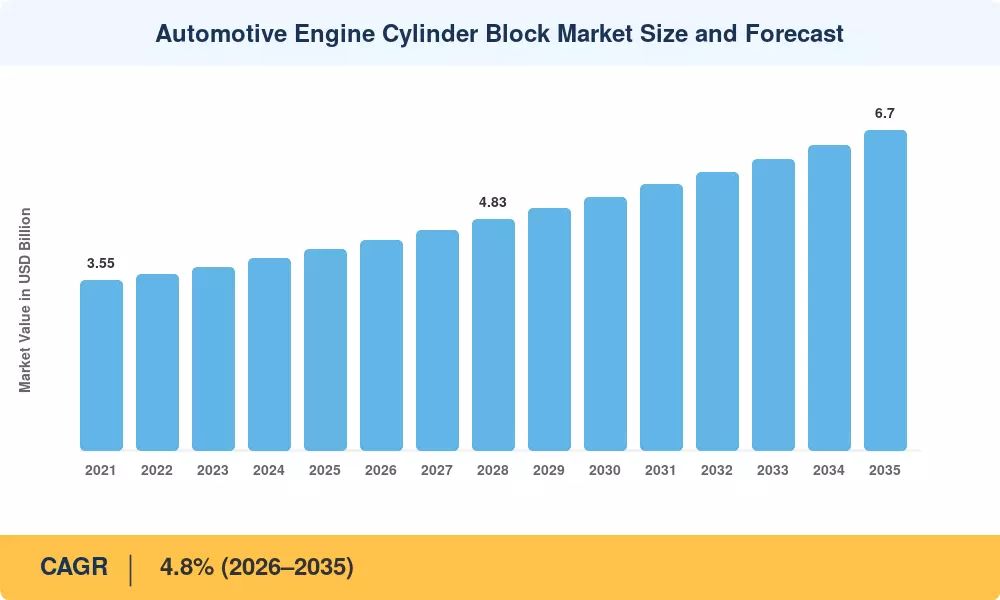
NEW YORK, NY, UNITED STATES, August 31, 2026 /EINPresswire.com/ — According to Market Research Future, the Automotive Engine Cylinder Block Market is projected to grow from USD 4.40 billion in 2026 to USD 6.70 billion by 2035, registering a CAGR of 4.8% during the forecast period, driven by Integration of lightweight materials enhances fuel efficiency. This steady growth reflects the ongoing evolution of internal combustion engine technology, where cylinder blocks—the structural foundation of automotive engines—are undergoing significant transformation as manufacturers prioritize weight reduction, thermal efficiency, and compatibility with hybrid powertrains.
Market Overview
Automotive engine cylinder blocks form the structural backbone of internal combustion engines, housing the cylinders, pistons, and crankshaft while providing mounting points for cylinder heads, manifolds, and ancillaries. These components are critical to engine durability and performance, operating under extreme temperatures, pressures, and mechanical loads. The market encompasses two primary material categories—cast iron and aluminum alloy—across passenger car and commercial vehicle applications, with OEM sales channels dominating due to the factory-fit nature of these components. The Automotive Parts and Components Market continues to expand alongside the broader component ecosystem, while the Automotive Component Automotive Cylinder Head Market complements cylinder block demand as automakers pursue integrated engine system optimization.
The key growth drivers propelling this market expansion include the increasing adoption of lightweight materials to enhance vehicle fuel efficiency and reduce emissions, driven by regulatory mandates including US CAFE, Euro 7, and China CAFC compliance pathways requiring vehicle weight reduction . Automakers are shifting toward aluminum cylinder blocks for passenger cars, as aluminum offers significant weight savings over traditional cast iron while maintaining sufficient structural integrity. The growing demand for hybrid vehicles creates continued demand for engine blocks optimized for hybrid powertrains . Advanced casting technologies and compacted graphite iron adoption in heavy-duty diesel engines support improved combustion pressures and downsizing benefits .
Market Segmentation
The automotive engine cylinder block market is segmented based on material type and vehicle type to provide comprehensive insights into the industry landscape.
By Material Type: The market is categorized into Cast Iron and Aluminum Alloy segments. Aluminum alloy is the fastest-growing and increasingly the largest material category in passenger car cylinder block applications . The shift is driven by fuel-economy compliance pathways requiring vehicle weight reduction, with aluminum blocks delivering substantial mass savings compared to cast iron counterparts . Cast iron retains significant share in heavy commercial vehicle applications and certain mass-market diesel programmes, offering superior durability, thermal stability, and cost-effectiveness for high-stress applications . Compacted graphite iron is gaining specification in heavy-duty diesel engines from Daimler Truck, PACCAR, Volvo Trucks, and Cummins for improved combustion pressures and downsizing benefits .
By Vehicle Type: The market serves Passenger Cars and Commercial Vehicles segments. Passenger cars dominate the cylinder block market, anchored by global passenger car ICE and hybrid production volumes . Commercial vehicles support continued cylinder block demand across pickup, van, and truck production, particularly in North America and Latin America . Heavy commercial vehicles drive compacted graphite iron and high-strength cast iron block demand across major OEM programmes .
By Region: The market analysis covers North America, Europe, South America, Asia Pacific, and the Middle East and Africa. Asia Pacific leads global cylinder block demand, anchored by Chinese, Japanese, Korean, Indian, and ASEAN passenger car and commercial vehicle production . North America is supported by US, Mexican, and Canadian aluminium-block casting capacity serving Ford, GM, and Stellantis powertrain programmes .
🛒 You can buy this market report at:
https://www.marketresearchfuture.com/checkout?currency=one_user-USD&report_id=26185
Key Industry Developments
Recent industry developments highlight the dynamic nature of the automotive engine cylinder block market. In April 2024, Nemak, S.A.B. de C.V., a specialist in developing and manufacturing aluminium components for e-mobility, received Aluminium Stewardship Initiative’s Performance Standard V3 (2022) Certification for three of its global production facilities in Poland, Slovakia, and Brazil . The Brazil facility specializes in engine blocks, cylinder heads, and transmissions, demonstrating the company’s commitment to sustainable manufacturing practices.
MAHLE GmbH, headquartered in Stuttgart, Germany, restructured its operations effective January 2025, merging its former Engine Systems and Components and Electronics and Mechatronics units into a new Powertrain and Charging business unit . The restructuring connects MAHLE’s century of engine systems expertise with electrification competencies, supporting continued cylinder block, piston, ring, and liner supply alongside expanding electric motor and charging system development across global ICE, hybrid, and BEV programmes .
Ryobi Aluminium Casting (UK) Ltd, a subsidiary of Ryobi Limited (Japan), completed investment in the latest high-pressure die-casting technology for engine block production at its UK facility, expanding capacity for European OEM aluminium block programmes . The investment supports Ryobi’s global aluminium die-casting position across Japanese, North American, and ASEAN production operations, reinforcing supply to Toyota, Honda, Nissan, Ford, Stellantis, and other major OEMs.
Competitive Landscape and Key Players
The automotive engine cylinder block market features a competitive landscape of global casting specialists, automotive suppliers, and foundries competing through material innovation, manufacturing capability, and strategic OEM partnerships. Competition centers on developing lightweight yet durable blocks for diverse powertrains, with OEM-aligned foundries leading in integrated engine solutions while material specialists pioneer advanced alloys .
Key players operating in this market include Nemak, S.A.B. de C.V., Ryobi Limited, Rheinmetall AG, Martinrea International Inc., Mahle GmbH, Linamar Corporation, GF Casting Solutions, and Dongfeng Motor Parts and Components Group Co., Ltd . Martinrea International Inc., headquartered in Vaughan, Ontario, Canada, showcased its V8 cylinder block and broader aluminium-casting and structural components portfolio at the 2025 JSAE Automotive Engineering Exposition, supplying aluminium engine blocks, structural components, and fluid systems to Ford, General Motors, Stellantis, and Honda .
Strategic developments are reshaping the competitive landscape. Regional players in Asia leverage cost advantages in high-volume production, while European and American firms dominate premium and performance segments . Strategic automaker partnerships are critical, particularly for developing hybrid-compatible block architecture . The aftermarket sees growing competition from certified remanufactured blocks .
To explore more market insights, visit us at:
https://www.marketresearchfuture.com/reports/automotive-engine-cylinder-block-market-26185
Final Market Summary
The automotive engine cylinder block market is positioned for steady growth, driven by lightweighting trends, hybrid powertrain development, and continued internal combustion engine production across global markets. The market’s trajectory from USD 4.40 billion in 2026 to USD 6.70 billion by 2035 reflects the ongoing evolution of engine technology as manufacturers balance performance, efficiency, and sustainability requirements.
The long-term industry potential remains supported by continued passenger car and commercial vehicle production, the growing hybrid vehicle segment, and advances in casting technology and material science. Strategic partnerships between automakers and suppliers, investment in advanced manufacturing capacity, and material innovation for weight reduction and thermal efficiency will be critical success factors as the market adapts to changing powertrain demands.
Key factors expected to influence future development include the pace of hybrid vehicle adoption, the evolution of emission and fuel-economy regulations, and the continued shift toward lightweight materials across vehicle segments. Suppliers that invest in flexible casting capacity, advanced alloy development, and strategic OEM partnerships will capture value in the evolving engine technology landscape.
More Related Reports from MRFR Library:
Efuse Market : https://www.marketresearchfuture.com/reports/automotive-efuse-market-31481
Intralogistics Automation Solution Market : https://www.marketresearchfuture.com/reports/intralogistics-automation-solution-market-33134
EV Charger Operation Maintenance Service Market : https://www.marketresearchfuture.com/reports/ev-charger-operation-maintenance-service-market-33233
Fuel Cell Bike Market : https://www.marketresearchfuture.com/reports/fuel-cell-bike-market-33401
E Bike Rental Market : https://www.marketresearchfuture.com/reports/e-bike-rental-market-35290
Electric and Autonomous Vehicles Wiring Harness Market : https://www.marketresearchfuture.com/reports/electric-autonomous-vehicles-wiring-harness-market-35296
External Cloud Automotive Cyber Security Service Market : https://www.marketresearchfuture.com/reports/external-cloud-automotive-cyber-security-service-market-35477
Automotive OLED Market : https://www.marketresearchfuture.com/reports/automotive-oled-market-38555
Motorsports Market : https://www.marketresearchfuture.com/reports/motorsports-market-43811
India Motorsport Products Market : https://www.marketresearchfuture.com/reports/india-motorsport-products-market-44438
Market Research Future
Market Research Future
+ +1 855-661-4441
email us here
Legal Disclaimer:
EIN Presswire provides this news content “as is” without warranty of any kind. We do not accept any responsibility or liability
for the accuracy, content, images, videos, licenses, completeness, legality, or reliability of the information contained in this
article. If you have any complaints or copyright issues related to this article, kindly contact the author above.

Media gallery